
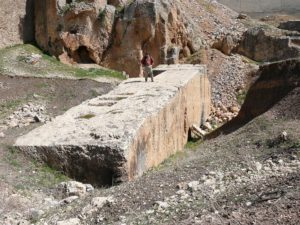
The question still remains, “How did the ancients move blocks of stone the size of a school bus?” As evidenced by the stone megaliths all over the world. Many defy explanation either because of their sheer size or because of the precision with which they were dressed and laid. In the temple base at Baalbek, for example, most of the stones “range in size from thirty to thirty three feet in length, fourteen feet in height and ten feet in depth, and weigh approximately 450 tons each. Nine of these blocks are visible on the north side of the temple, nine on the south and six on the west (others may exist but archaeological excavations have thus far not dug beneath all the sections of the Grand Terrace).”(Alouf, History of Baalbek, 1999) These blocks, 450 tons each, are not even the biggest of the stones they moved.

How do we do it today?
Rock quarries of today use one of three methods to cut blocks that are normally 40 x 30 x 17 feet: a pneumatically powered drill (air powered), a diamond wire saw (which uses a diesel motor) or a water jet (which uses a diesel motor and a pneumatic drill). However, even a 40 x 8 x 6 ft. block would weigh more than 190 tons so they further cut them into 10 x 5 x 5 feet blocks (still more than 20 tons) before using steel derricks (stationary cranes) to lift them out. In the 1800s wooden derricks were used which could lift 40 tons. The steel derricks of today can lift between 100 and 250 tons but use electricity to power them.
What is the problem?
It is hard to imagine the amount of time needed to chip a block of stone a few feet in length much less blocks that weigh hundreds of tons each. Let’s say that somehow they do managed to cut these blocks, how then did they lift them into place? There is a very interesting article about Baalbek on www.sacredsites.com a portion of which is used here with permission.
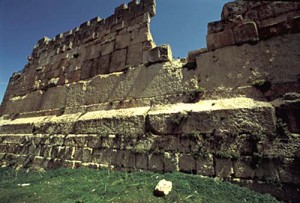 “The great mystery of the ruins of Baalbek, and indeed one of the greatest mysteries of the ancient world, concerns the massive foundation stones beneath the Roman Temple of Jupiter. The courtyard of the Jupiter temple is situated upon a platform, called the Grand Terrace, that consists of a huge outer wall and a filling of massive stones. The lower courses of this great outer wall are formed of huge, finely crafted and precisely positioned blocks. Above the six blocks on the western side are three even larger stones, called the Trilithon, whose weight exceeds 1000 tons each. These great stones vary in size between sixty-three and sixty-five feet in length, with a height of fourteen feet six inches and a depth of twelve feet.”(www.sacredsites.com)
The most intriguing part of Baalbek is the block of limestone that was never used from a quarry one-quarter mile away. At sixty-nine feet by sixteen feet by thirteen feet ten inches, it was the largest of them all. I asked some crane operators what this block would weigh and could it be lifted with today’s cranes, This is the answer I got from J.D. Mitchell, P.E., Crane and Hoist Engineering (Gresham, Oregon):
“I can calculate the weight of the limestone block for you. According to my engineering handbook, limestone weighs between 130 and 180 pounds per cubic foot. A block 69′ X 16′ X 13′-10″ would have a volume of 15,272 cubic feet. At 130#/CF the block would weigh 1,985,360 pounds or 902 tonnes (992 tons). At 180#/CF it would weigh 2,748,960 pounds or 1,250 tonnes (1374 tons).”
 Bruce Stemp from Lampson Intl. told me, “It would take a crane of similar size to this to place the large stones you are talking about. This is a Lampson LTL-1500 Transi-Lift and is capable of lifting 1500 tons. The lift radius and other factors reduce this capacity so to place the stones at height and distance requires a crane with higher ultimate capacity.”
Two more points made in the sacredsites’ web article that were particularly interesting concern the method of transportation and a comparison given as an example of lifting capacity during the Renaissance:
“Why these stones are such an enigma to contemporary scientists, both engineers and archaeologists alike, is that their method of quarrying, transportation and precision placement is beyond the technological ability of any ancient or modern builders. Various ‘scholars’, uncomfortable with the notion that ancient cultures might have developed knowledge superior to modern science, have decided that the great Baalbek stones were laboriously dragged from the nearby quarries to the temple site. While carved images in the temples of Egypt and Mesopotamia do indeed give evidence of this method of block transportation – using ropes, wooden rollers and thousands of laborers – the dragged blocks are known to have been only 1/10th the size and weight of the Baalbek stones and to have been moved along flat surfaces with wide movement paths. The route to the site of Baalbek, however, is up hill, over rough and winding terrain, and there is no evidence whatsoever of a flat hauling surface having been created in ancient times.”
“Next there is the problem of how the mammoth blocks, once they were brought to the site, were lifted and precisely placed in position. It has been theorized that the stones were raised using a complex array of scaffolding, ramps and pulleys that was powered by large numbers of humans and animals working in unison. An historical example of this method has been suggested as the solution for the Baalbek enigma. The Renaissance architect Domenico Fontana, when erecting a 327-ton Egyptian obelisk in front of St Peter’s Basilica in Rome, used 40 huge pulleys, which necessitated a combined force of 800 men and 140 horses. The area where this obelisk was erected, however, was a great open space that could easily accommodate all the lifting apparatus and the men and horses pulling on the ropes. No such space is available in the spatial context of how the Baalbek stones were placed. Hills slope away from where lifting apparatus would need to have been placed and no evidence has been found of a flat and structurally firm surface having been constructed (and then mysteriously removed after the lifting was done). Furthermore, not just one obelisk was erected but rather a series of giant stones were precisely put in place side-by-side. Due to the positioning of these stones, there is simply no conceivable place where a huge pulley apparatus could have been stationed.”
In conclusion, there are basically 3 options we have to explain this puzzle. Either our ancestors possessed greater technology that previously thought, they were giants with exponential strength or they simply enjoyed spending centuries chipping and lugging around huge stone blocks. If you would like to learn more about ancient technology click here.